
 800-538-3767

Own Specialty
Disability Insurance
Own Occupation Disability Insurance (Own Specialty Specific or Regular Occupation) provides a replacement of income if a sickness or injury prevents you from working in your “Regular Occupation.” You will still be considered “Totally Disabled” and eligible to receive your “full” benefit even if you elect to work in another occupation.
Our Services
When you decide to purchase your insurance policy through an independent agent, you gain access to quotes and packages from various providers. InsuranceMD can help you compare policies and choose the one that best suits your needs and budget.

Own Specialty Disability Insurance for Physicians
True Own Specialty disability insurance gives you financial protection from any illness or injury that prevents you from working in your medical specialty, while still allowing you to collect your full benefit even if you elect to work in another occupation.

Life Insurance for Physicians
We offer life insurance solutions designed specifically for physicians.

Business Overhead Insurance for Your Practice
Don’t let a disability put you out of business. Ensure your expenses are covered should an injury or illness impact your ability to work.
The value of true own Specialty Disability Insurance
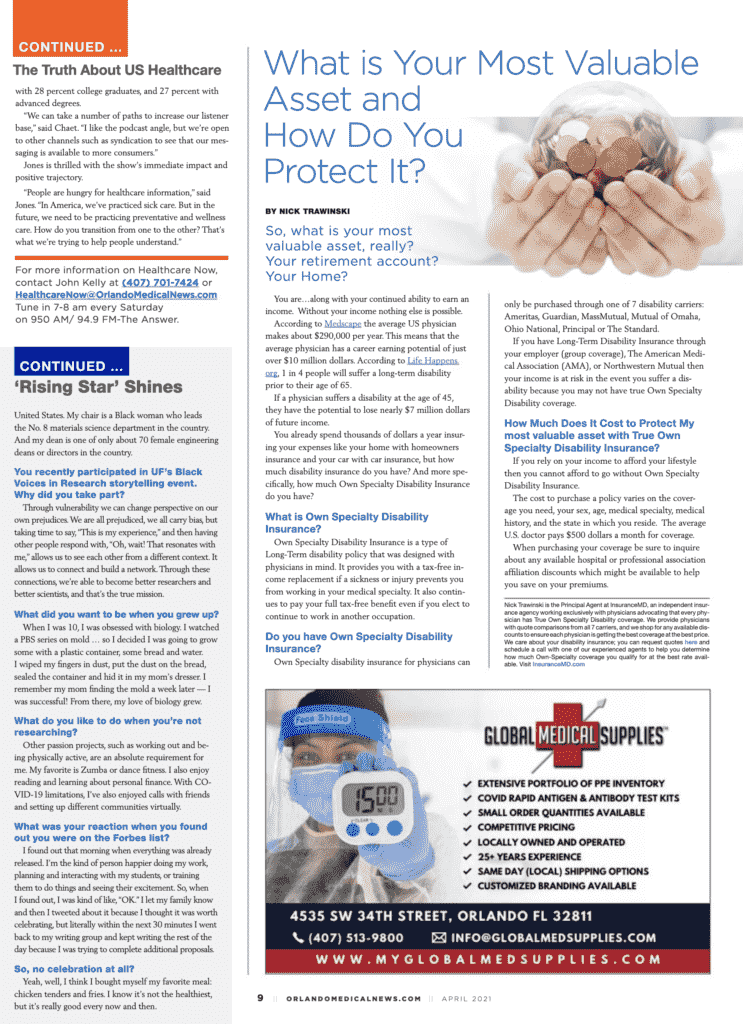
1 in 4 physicians will suffer a disability lasting more than 90 days prior to their age of 65. If you rely on your income to support your lifestyle then your most valuable asset is your ability to earn an income and you must take the proper steps to protect your income.
Protecting your most valuable asset with ‘True Own-Specialty Disability Insurance.’

Articles & Discussions

3 Tiers of Own Occupation Disability Insurance
Own Occupation Disability Insurance Own Occupation Disability insurance is invaluable to physicians, however, there are […]

Comprehensive Guidance on Own Specialty Disability Insurance: Essential Insights for Physicians
In the multifaceted and dynamic landscape of healthcare, physicians not only bear the noble responsibility […]

Protecting Your Medical Specialty: Why Physicians Shouldn’t Skimp on Disability Insurance
In the high-stakes world of medicine, physicians invest years of rigorous training and substantial financial […]
Unveiling the Risks of Subjective Financial Advice: The Case of the White Coat Investor
Introduction: The White Coat Investor, a popular platform offering financial advice tailored to physicians, has […]

Examining the Disappearance of Gender-Neutral Disability Insurance Options for Female Physicians
Disability insurance serves as a crucial safeguard for physicians, offering financial protection in the event […]
InsuranceMD Publications
Own Specialty Disability Insurance FAQs
What Is True Own Specialty Disability Insurance?
True Own Specialty disability insurance defined in the definition section of your policy under “Total Disability” or “Totally Disabled” and this is the language the carrier uses to determine when, or if, they consider you disabled and eligible to receive your benefit payments.
Being disabled should not be simply defined as a sickness or injury that prevents you from “working.” Based on your education and experience in becoming a physician, it is going to take a lot to prevent you from “working” in some capacity.
Your disability insurance policy must define you as disabled if a sickness or injury makes it so you are no longer able, or you are no longer comfortable, working as a physician – and it should not penalize you if you engage in another occupation.
As with many important decisions; the devil is in the details… This is very true when it comes to disability insurance, and the carriers make the details and specifics of their policies a challenge to understand.
Does your policy say: “We will consider you disabled when you cannot perform the duties as a physician, and you prove to us that you cannot perform the duties of any other reasonable occupation?”
This definition is offered by some group policies and is not desirable.
Does your policy say: “We will consider you disabled when you cannot perform the duties as a physician, so long as you are not gainfully employed in any other occupation from now until the age of 65”.
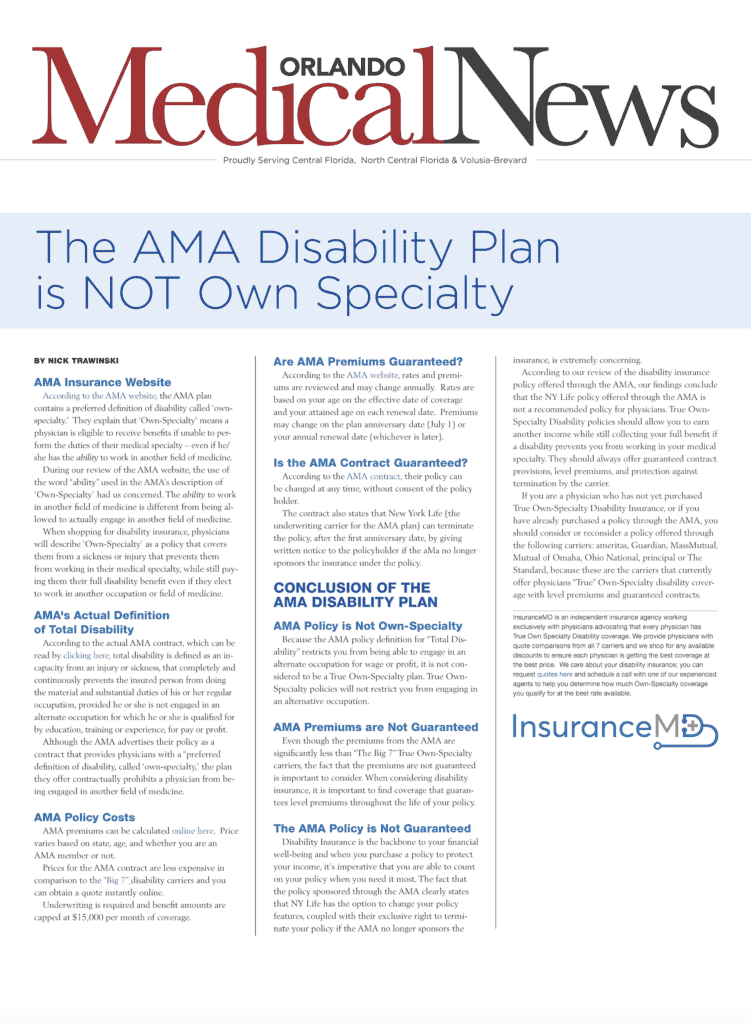
This definition is offered through some group policies, the AMA and other professional medical association plans, and is also not desirable.
Your policy should say: “You are considered totally disabled when you are unable to work as a physician, and we will still consider you totally disabled even if you work in another occupation”.
This definition of disabled is the only one considered TRUE Own Specialty, and the type of coverage you should have. This means if you cannot continue working as a physician, you can do something else AND collect your tax-free disability benefit.
Where Can I Get True Own Specialty Disability Insurance?
True Own Specialty Disability Insurance can only be purchased individually. It is not offered through Group Sponsored Long Term Disability plans or professional Association plans through associations like the AMA – ADA – ACOG – ACP – AAP – ACS, etc.
Currently the only seven disability carriers that offer True Own Specialty Disability Insurance are Ameritas – Guardian – MassMutual – Mutual of Omaha – Ohio National – Principal – and The Standard.
Is My Employer's Disability Plan True Own Specialty?
Employer-sponsored group disability insurance does not offer the same level of coverage as Individual Own Specialty Disability Insurance. With your employer plan:
- You could lose your benefit if you change jobs or if your employer switches the group benefits they offer.
- Your policy is subject to changes by the insurance carrier and your employer.
- The Definition for Total Disability prevents you from collecting your full disability benefit if you are working or earning an income in another occupation.
- Benefits are often taxable since your employer is paying the premium.
When Should I Buy Disability Insurance?
The best time to buy disability insurance is when you don’t need disability insurance. In order to qualify for disability insurance, you must first apply for the benefit, so the earlier the better. We encourage that you start with a plan early during your residency when you are at your healthiest. Securing a plan during residency and adding a future purchase option protects your future insurability as your income increases regardless of your health.
What Is the Most Important Feature of a Disability Policy?
The most important feature of your disability insurance policy is the definition of Total Disability. Total Disability defines when the insurance carrier considers you to be totally disabled and eligible for your full monthly disability benefit. Physicians are advised to obtain a policy with a definition of Total Disability that does not contain language that prohibits you from working in another occupation. Physicians refer to this plan as an Own Specialty Disability policy because the definition of Total Disability will consider you totally disabled even if you elect to work in another occupation. Currently, only six carriers offer such a policy to physicians: Ameritas – Guardian – MassMutual – Mutual of Omaha – Principal – The Standard.
How Much Disability Insurance Should I Purchase?
If you pay for your own private disability policy, your benefits will be paid to you Tax-Free. During your residency, the maximum benefit you are eligible for is $5,000 per month. If you add a Future Purchase Rider you will be permitted to increase your benefit as your income increases regardless of your health. As your income increases so should your disability benefit and the amount you qualify for is based on your income at the time you apply for a new policy or an increase in coverage. The more income you earn, the more disability you should have. As a physician, the maximum combined individual own specialty benefit you can own is $30,000 per month.
How Much Will Disability Insurance Cost Me?
True Own Specialty Disability Insurance is not like the other insurance policies you may be used to paying for. This is a policy that protects your most valuable asset, your income. And according to statistics between 1 in 4 healthy 20-year-olds will suffer a long term disability prior to their retirement age. This explains why it costs so much because it actually gets used. Rates vary based on various different factors: The state you live in, whether you are a male or female, the benefit
amount you are eligible for and the riders you add to your policy, and your medical specialty. The average resident will pay between $180 and $220 per month for a $5,000 per month Own Specialty Disability plan. It’s not uncommon as you increase your monthly benefit as your income rises that you are paying between $600 – $800 per month for your policy. This may come as a shock but it’s a necessary benefit. Until the day comes where you’ve reached financial independence and 100% of your income is considered disposable income you need disability insurance.
What Carriers Should I Consider?
You should consider carriers that offer a True Own Specialty Definition of Total Disability. Only six carriers remain that offer this benefit: Ameritas – Guardian – MassMutual – Mutual of Omaha – Principal – The Standard.
Despite what you read or what a captive agent may tell you, carriers like Northwestern Mutual or plans sponsored through your employer or professional medical association like the AMA – ACP – ACOG, etc. do not offer a True Own Specialty Definition for Total Disability because their definition restricts your ability to collect your full benefit if you are working or earning another income in another occupation.
Are There Any Exclusions?
Prior to qualifying for a disability insurance policy, you must submit to medical underwriting. The insurance carrier will review your medical history to determine if any of your pre-existing medical conditions will be excluded. In some cases exclusions are temporary and the carrier may be willing to reconsider an exclusion after some time has passed and your pre-existing medical condition is no longer a risk to the carrier. 1 in 3 disability policies are approved with an exclusion, it’s typical. It’s important to realize that when an exclusion is added to your policy it’s just an exclusion for your pre-existing condition and that in most cases any new trauma, burn, laceration, or neoplasm that is not caused by your pre-existing condition will still be considered a covered claim. If after review of your application they issue you a policy without any exclusions, then you can rest assured that ANY sickness or injury that impacts your ability to work in your occupation will be covered. Limitations for Mental/Nervous disabilities are part of most contracts where the carrier will only pay your benefit for up to 24 months if your disability is a result of things like anxiety, depression, or substance abuse.
My employer offers me disability insurance, why do I need this?
All physicians should have individual coverage as a supplement to your group insurance. Here is why:
- Your Group Long-Term Disability Policy is not a True Own-Specialty policy. A True Own-Specialty Disability policy pays you a tax-free income should a sickness or injury prevent you from working in your medical specialty. Under a True Own-Specialty definition of disability, you will continue to receive your full tax-free benefit even if you elect to work in another occupation. You Group LTD does not offer that benefit.
- Your Group Long Term Disability Plan can be cancelled or modified. A True Own Specialty policy remains the same for the life of the policy.
- Your Group Policy pays you a taxable benefit calculated solely on your “base” income. A True Own-Specialty policy pays you a tax-free benefit taking all of your income into account.
When Can I Cancel My Disability Policy?
You can cancel your disability policy at any time. It’s recommended that you keep your disability policy until you retire or until you have reached a point of 100% financial independence and your income is no longer needed to sustain your standard of living.
Who Should I Buy A Policy From?
You will want to buy your policy from an independent agent. Shopping the rates and discounts from all 7 carriers is the best way to ensure you are getting the most value from the money you are spending.
The majority of agents will quote between 1 and 3 carriers and try to convince you that 1 of those carriers is best for you. However, the best is different for everyone and every carrier offers virtually identical Own Specialty Plans. So long as you are comparing quotes with the same riders and definitions then the carrier that’s offering you the best price wins.
Here at Insurance MD, we provide you with side by side quotes from all 7 carriers so you can rest assured that you are getting the best policy at the best price. We also shop to make certain you are receiving all the discounts you may be eligible to receive based on your Hospital Affiliation or Professional Association Affiliations.